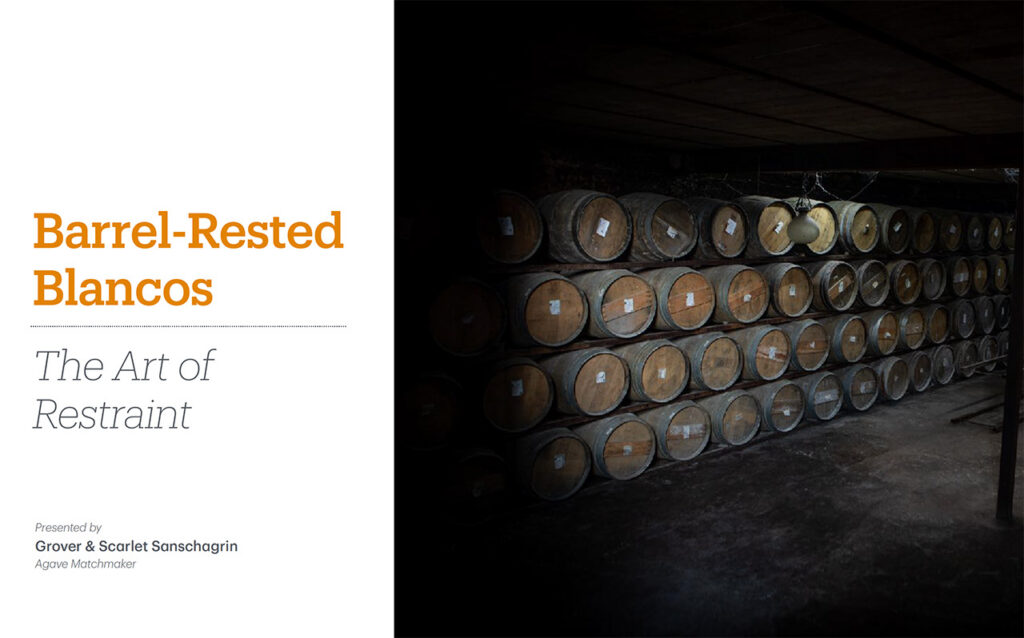
The Art of Restraint: The Science Behind Barrel-Rested Blancos
Most people think of tequila aging as a waiting game. Put tequila into a barrel, let time pass, and eventually it becomes a reposado or an añejo. But there is another category that often goes unnoticed, one that challenges the idea that more time is always better.
Barrel-rested blancos spend less than two months in oak. According to Mexico’s tequila standard (NOM-006), a blanco tequila may undergo maturation for less than two months and still be classified as a blanco.
That short window creates one of the most difficult balancing acts in tequila production.
The goal is not to make the tequila taste like wood, but instead to make it taste like a better version of itself.
Done well, a barrel-rested blancos can preserve the bright aromas of cooked agave while adding subtle hints of vanilla, sweetness, texture, and complexity. Done poorly, the barrel quickly begins to overpower the spirit, pushing it toward reposado territory before it has had a chance to fully develop.
This is the art of restraint.
More Than a Storage Container
When people picture a barrel, they often imagine a wooden container simply holding tequila until it is ready to bottle. Although technically true at the surface level, it isn’t actually what’s happening in reality.
A barrel is not passive because it is an active participant in maturation. Every day that tequila rests inside, thousands of chemical reactions occur between the spirit, the wood, and the surrounding environment. So, a better way to think about a barrel is as a chemical reactor.
Instead of simply storing tequila, the barrel continuously changes it through extraction, adsorption, oxidation, and esterification. Each of these processes contributes something different.
Some of the barrel’s compounds enter the tequila while others disappear, being absorbed into the wood. And others are transformed into entirely new aroma molecules.
Together, they create the gradual evolution that distillers carefully monitor throughout maturation.
Why Rest a Blanco at All?
If the goal is to preserve fresh agave character, why place the tequila into a barrel in the first place? Because even a few weeks in oak can improve the spirit without completely changing its identity.
The objective is not to produce a reposado. Instead, distillers are looking for three things:
- Soften rough edges
- Increase complexity
- Add texture
All while preserving the cooked agave, minerality, citrus, and herbal notes that define a great blanco.
Finding that balance is much more difficult than it sounds. A heavily aged tequila can tolerate stronger oak influence because the barrel is expected to become part of its personality.
A barrel-rested blanco has no such luxury.
Every additional day matters.
Four Processes Shape Every Barrel-Rested Blanco
Although we often describe barrel aging as a single process, four different chemical events are taking place simultaneously.
1. Extraction
This is the process most people are familiar with, where compounds move from the wood into the tequila.
Among the most important are:
- Vanillin
- Oak lactones
- Eugenol
- Tannins
Each contributes something different. Vanillin provides familiar aromas of vanilla, cream soda, and baking sweetness. Oak lactones contribute coconut, cream, sweet oak, and woody aromas. Eugenol introduces warm spice notes reminiscent of cloves, cinnamon, and nutmeg. And tannins add structure and a gentle drying sensation that gives the spirit more grip on the palate.
Extraction is often the fastest of the four processes, especially during the first several weeks, and even faster if the tequila inside the barrel is high proof.
2. Adsorption
Adsorption is one of the least understood aspects of barrel maturation. Unlike extraction, where compounds leave the wood and enter the tequila, adsorption works in the opposite direction.
Certain undesirable molecules leave the tequila and attach themselves to the interior surface of the barrel. Among these are sulfur-containing compounds that can contribute harsh or rough aromas.
As these compounds become trapped within the wood, the tequila often tastes smoother and cleaner without adding anything new to the spirit. Sometimes making a tequila “better” isn’t about adding flavor, but removing distractions.
3. Oxidation
Oak barrels slowly breathe. Tiny amounts of oxygen move through the wood over time, allowing slow oxidation to occur. This is not the rapid oxidation that spoils an open bottle of wine.
Instead, it is an extremely gentle process that encourages existing aroma compounds to evolve into softer, more integrated forms. Sharp edges begin to round off, and individual aromas become less isolated and more harmonious.
Many people describe the result simply as “better integrated,” even though dozens of microscopic reactions are responsible.
4. Esterification
While extraction adds molecules from the barrel, esterification actually creates entirely new aroma compounds inside the tequila itself. Organic acids react with alcohol molecules to form esters, many of which have pleasant fruity and floral aromas.
The tequila is not simply absorbing flavors from oak. Its chemistry is actively changing the liquid inide, and that’s why maturation is far more than extraction alone.
Where Does the Vanilla Come From?
Vanilla is often the very first flavor people notice in a barrel-rested blanco. However, the barrel wasn’t made from vanilla beans, so where does this come from?
The source is lignin.
Lignin is one of the major structural components of oak. During barrel construction, the cooper heats the inside of the barrel through toasting or charring. Heat breaks apart portions of the lignin, producing aromatic compounds including vanillin.
Once tequila enters the barrel, ethanol and water dissolve those molecules and gradually carry them into the spirit. That is why vanilla often appears surprisingly early during maturation.
The Truth About Wood Sugars
Many people assume barrels simply contain sugar that dissolves into tequila. But in reality, since wood is primarily composed of cellulose, hemicellulose, and lignin, a reaction occurs during barrel toasting.
During the toasting procees, heat begins breaking down hemicellulose into much smaller carbohydrate molecules, often referred to as “wood sugars.” These compounds slowly dissolve into the tequila during maturation.
Although laboratory analysis can measure increasing sugar concentrations over time, those numbers tell only part of the story. And, many of the compounds responsible for perceived sweetness are not sugars at all.
- Vanillin
- Maltol
- Furfural
These are caramel-like compounds produced during the barrel toasting process, and together they create the impression of sweetness, even when only tiny amounts of actual sugar have entered the tequila.
Our own laboratory testing has shown measurable increases in sugars as tequila spends time in oak, confirming that extraction is occurring. But what our senses perceive as sweetness is the combined effect of sugars, aromatic compounds, and changes in texture.
Why Mouthfeel Changes
One of the most noticeable differences in a barrel-rested blanco is texture. The spirit often feels rounder, softer, and more luxurious than its unaged counterpart.
Some of that comes from adsorption removing harsher compounds, and some comes from oxidation creating better integration. And some comes from wood-derived compounds that increase viscosity.
Trace amounts of glycerol that survive distillation may also contribute to mouthfeel, although their concentrations remain low. Combined with oak-derived compounds and the removal of harsher congeners, these changes can make the tequila seem richer than its chemical composition alone would suggest.
In our own lab tests, we noticed that the amount of glycerin in barrel-aged products tends to increase as it ages. The theory is that while water and/or alcohol can escape from the barrel over time (evaporation and angel share), glycerin is a compound that stays behind.
The result is a spirit that feels smoother without necessarily becoming sweeter.
American Oak vs. European Oak
Not all oak behaves the same way.
American white oak is rich in cis-whiskey lactones, producing aromas often described as coconut, cream, vanilla, and sweet oak.
European oak generally contributes more trans-whiskey lactones and spice-forward compounds, producing grassy, herbal, and woody characteristics.
The cooper’s toasting decisions matter just as much as the species.
Light toast preserves more lactones.
Heavy toast breaks down more lignin, increasing vanilla, caramel, toasted bread, and baking spice aromas while reducing some of the fresh coconut character.
Every barrel begins telling its own story long before tequila is ever added.
The First 60 Days
The earliest weeks inside a barrel are remarkably active.
During the first week, vanilla begins to appear, oak lactones emerge, and perceived sweetness increases.
By the second through fourth weeks, ethanol continues dissolving wood compounds while oxidation and adsorption soften the spirit and expand its mouthfeel.
Between the fourth and eighth weeks, oak influence accelerates. Barrel compounds continue increasing while the fresh agave character begins to slowly fade. Dryness also becomes more noticeable as tannins accumulate.
This is where the distiller’s experience becomes invaluable.
There is no universal schedule. Some tequilas are ready after only a few weeks, while others benefit from additional time.
The challenge is recognizing the precise moment when the barrel has improved the tequila without beginning to dominate it.
The Invisible Ingredient
One aspect of maturation is rarely discussed.
Most tequila is aged in previously used bourbon barrels, and these barrels are not totally empty. Even after bourbon is removed, a small amount remains absorbed within the wood.
As tequila enters the barrel, some of those compounds also become part of the extraction process.
The tequila isn’t simply interacting with oak, it is interacting with years of history stored inside that oak.
This is one reason why first-use barrels often behave differently than barrels that have already held tequila several times.
Why This Category Matters
Barrel-rested blancos are becoming increasingly popular because they offer something many tequila enthusiasts seek. They preserve the vibrant character of a blanco while adding enough complexity to reward slow sipping.
For producers, however, they are among the most difficult tequilas to make well.
Adding heavy barrel influence is relatively straightforward. But adding just enough requires patience, careful tasting, and the willingness to stop before the barrel takes over. Which is why this category deserves far more attention than it often receives.
It represents restraint instead of excess, precision instead of power, and subtlety instead of spectacle.
The Art of Knowing When to Stop
Every day inside the barrel changes the tequila. Some of those changes are obvious, and some others happen one molecule at a time.
Vanilla emerges, oak lactones appear, harsh compounds disappear, new esters form, and wood sugars slowly dissolve.
Throughout this process, texture becomes richer as the spirit grows more integrated.
But eventually, another change begins as the barrel starts speaking louder than the agave.
The finest barrel-rested blancos are bottled just before that happens. When everything comes together, the result doesn’t taste like oak, it tastes like tequila that has simply become more complete.
And that is the true art of restraint.